
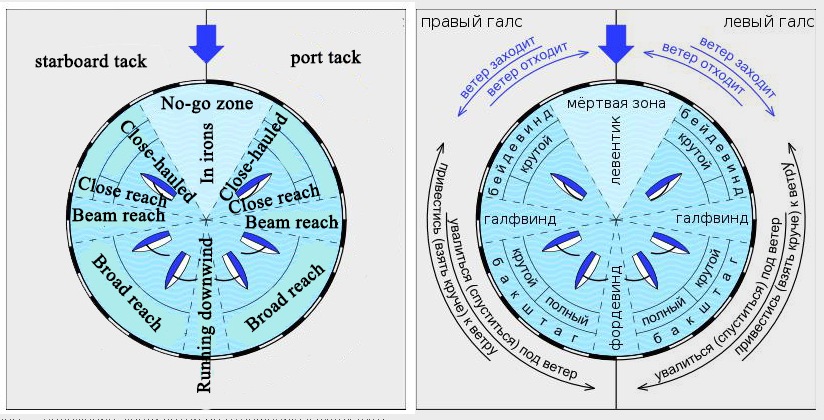
Starboard - The right side of the boat.
Port - The left side of the boat.
Starboard tack
When sailing with the wind coming from the starboard side of the vessel.
Port t tack a sailboat's heading when the wind is coming from the left, or port, side.
Іn irons
Stopped head-to-wind, a sailboat is said to be "in irons".
No-go zone
The range of directions into which a boat cannot sail is called the 'no-go zone'. Its width depends on the design of the boat, its rig, and its sails, as well as on the wind strength and the sea state. Depending on the boat and the conditions, the no-go zone may be from 30 to 50 degrees either side of the wind, a 60 to 100 degree area centered on the wind direction.
Reaching
Sailing across the wind: from about 60° to about 160° off the wind. Reaching consists of "close reaching" (about 60° to 80°), "beam reaching" (about 90°) and "broad reaching" (about 120° to 160°). See also beating and running.
Сlose-hauled
Of a vessel beating as close to the wind direction as possible.
Close reach
This is an upwind angle between close-hauled and a beam reach.
Beam reach
This is a course steered at right angles to the wind on either port or starboard tack.
Broad reach
The wind is coming from behind the boat at an angle. This represents a range of wind angles between beam reach and running downwind. The sails are eased out away from the boat, but not as much as on a run or dead run (downwind run).
Running downwind
On this point of sail (also called running before the wind), the wind is coming from directly behind the boat. Running can be dangerous to those on board in the event of an accidental jibe.
Tacking or coming about is a sailing maneuver by which a sailing vessel (which is sailing approximately into the wind) turns its bow into the wind through the 'no-go zone' so that the direction from which the wind blows changes from one side to the other.
The opposite maneuver, i.e. turning the stern through the wind, is called jibing (or wearing on square-rigged ships). Tacking more than 180° to avoid a jibe (mostly in harsh conditions) is sometimes referred to as a 'chicken jibe'.
Beating is the procedure by which a ship moves on a zig-zag course to make progress directly into the wind (upwind). No sailing vessel can move directly upwind (though that may be the desired direction). Beating allows the vessel to advance indirectly upwind.
- блоґ Lukum
- Щоб додати коментар, увійдіть або зареєструйтесь
Коментарі
myk0l@y, Харків
Мне как-то привычнее - бакштаг, бейдвинд, галфвинд...
- Щоб додати коментар, увійдіть або зареєструйтесь
посилання]beshlebny, Мариуполь
Оля переведи, а то мы вашей барской грамоте не обучены ))) И каратинку подправь, а то ливентик широковат, а фордак совсем узкий )))
- Щоб додати коментар, увійдіть або зареєструйтесь
посилання]Lukum, Днепр
- Щоб додати коментар, увійдіть або зареєструйтесь
посилання]meral,
все четко. downwind это крайние два румба(вон те чернобелые черточки на кольце румбы)
а левентик середина мертвой зоны(лучик). мертвая зона - это как только идти не получится(нарисовано для яхт).
- Щоб додати коментар, увійдіть або зареєструйтесь
посилання]igor000,
London is the capital of Great Britan
- Щоб додати коментар, увійдіть або зареєструйтесь
посилання]softranger, Харків
- Щоб додати коментар, увійдіть або зареєструйтесь
посилання]beshlebny, Мариуполь
Еще для изучения)))
- Щоб додати коментар, увійдіть або зареєструйтесь
посилання]Dron, Нова Каховка
На оно на? ;-)
- Щоб додати коментар, увійдіть або зареєструйтесь
посилання]valeramj,
а где картинка от Куки?
- Щоб додати коментар, увійдіть або зареєструйтесь
посилання]petro68,
Где моторчик и как оно едет?
- Щоб додати коментар, увійдіть або зареєструйтесь
посилання]